

Shin Minjun Reclaims LG Cup Title in Historic Korea–Japan Final

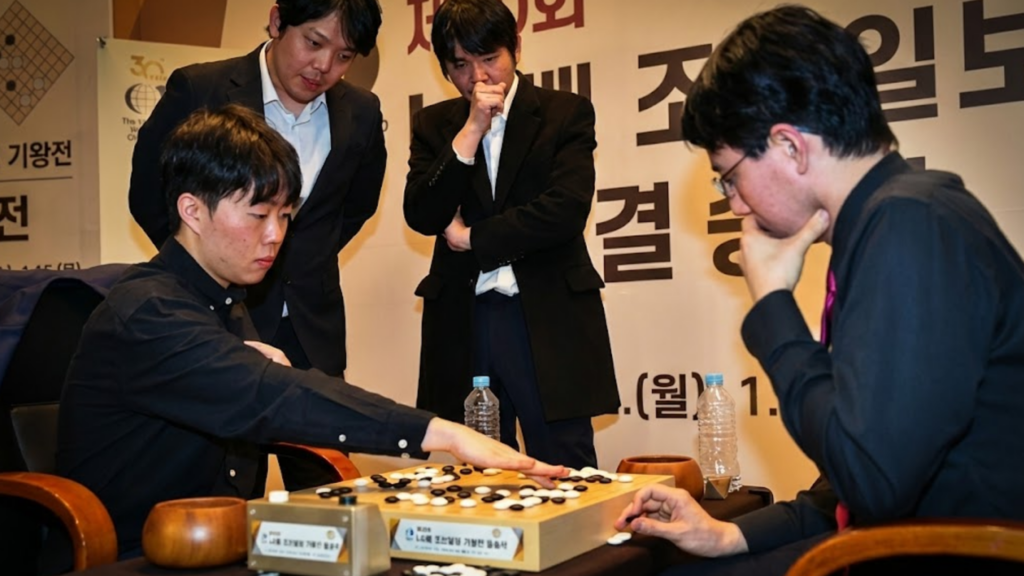
A Championship Showdown 28 Years in the Making
The 30th LG Cup World Go Championship concluded in Seoul with a thrilling best-of-three final between South Korea’s Shin Min-jun 9-dan and Japan’s Ichiriki Ryo 9-dan. This matchup carried historic significance: it was the first Korea–Japan title clash in the LG Cup in 28 years. Adding to the drama, Chinese players were absent from this edition due to a boycott stemming from a controversial ruling in last year’s final. Organizers filled the slots by inviting past champions from Korea, Japan, and Taiwan – a decision that paved the way for this rare East Asian showdown. Under intense international attention, Shin Min-jun emerged as the champion with a 2–1 victory, regaining the LG Cup crown he first won five years ago. The triumph was made sweeter for the 27-year-old Korean as it came in front of his teacher, the legendary Lee Sedol, who watched proudly as his pupil reclaimed the title.
Meet the Finalists: Rising Stars of Korea and Japan
Shin Min-jun is one of South Korea’s elite young players, part of the generation challenging the dominance of world #1 Shin Jin-seo. At 27, Shin already had one world major title under his belt – the LG Cup in 2020 (his first and until now only international championship). Known for his fighting spirit and sharp reading, he has been a top performer domestically and internationally, though often in the shadow of Korea’s very top players. Winning this LG Cup marks a comeback to the pinnacle after five years, underscoring that his 2020 title was no fluke. Notably, Shin is a disciple of Lee Sedol (18-time world champion), and Lee’s guidance was evident in Shin’s calm yet aggressive style throughout the tournament.
Ichiriki Ryo, 29, is the flag-bearer of Japan’s renewed presence on the world stage. He holds seven major Japanese titles (including the prestigious Kisei title) and has been leading the charge to revive Japan’s international Go standing. In 2024, Ichiriki made history by winning the Ing Cup – giving Japan its first world championship in 19 years. That victory, a 3–0 sweep in the Ing Cup final, firmly established him as one of the few Japanese players capable of going toe-to-toe with the best from Korea and China. Ichiriki’s run to the LG Cup final – defeating top Korean Byun Sang-il in the semifinal – further demonstrated his skill and tenacity. For Ichiriki, this LG Cup was an opportunity to secure a second world title and achieve a feat no Japanese player had managed in decades: winning the LG Cup (Japan’s last LG Cup champion was Cho U in 2005). The stage was set for a classic clash of styles – Shin’s calculated aggression versus Ichiriki’s precise, territorial play – with pride and history on the line for both countries.
The Road to the Final
This LG Cup had a unique path due to China’s withdrawal. The main tournament, held in late 2025, featured 24 players: 12 from Korea, 3 from Japan, 1 from Taiwan, and 8 wildcard invitees (former champions replacing the Chinese contingent). As a result, storied veterans like Japan’s O Rissei (1998 LG Cup winner) and Cho U (2005 winner), as well as Taiwan’s Zhou Jun-xun (2007 winner), joined the fray. The mix of generations produced some headline moments – for example, 16-year-old prodigy Nakamura Sumire defeated 62-year-old O Rissei in the opening round, symbolizing a passing of the torch. In the end, the tournament narrowed to four contenders: Korea’s Byun Sang-il and Shin Min-jun, Japan’s Ichiriki Ryo, and Taiwan’s Hsu Hao-hung. Ichiriki halted Byun’s run in one semifinal, while Shin ended Hsu’s Cinderella story in the other, setting up the first Korea–Japan LG Cup final since 1998. Both Shin and Ichiriki entered the final in peak form, each seeking to add another illustrious trophy to their careers.
A Three-Game Battle for the Title
The championship match was a best-of-three series, with each game played over 3 hours per player plus 5x40s byo-yomi (overtime) – a true test of endurance and concentration. The games were held on consecutive days in mid-January 2026 in Seoul. What unfolded was a dramatic, seesaw battle that kept Go fans worldwide on the edge of their seats.
Game 1: Ichiriki Strikes First
In the opening game, Ichiriki Ryo, playing black, took an early territorial lead while Shin Min-jun (white) built influence. Midway through, Shin engineered a complex fight on the left side that appeared to give him the advantage – commentators noted he “played very well and was leading for most of the game”. However, as the battle intensified, Shin made a costly misstep in that left-side skirmish. Sensing the moment, Ichiriki complicates the position and turns the tables. Shin’s serious mistake in the late middlegame allowed Ichiriki to kill a critical group and seize the lead. The momentum swing was decisive. Despite Shin’s efforts to create complications in the endgame, Ichiriki maintained a firm grip and eventually forced a resignation. It was a hard-fought victory for Ichiriki – snatching victory from the jaws of defeat in a game he himself described as “very tough.” This gave the Japanese challenger a 1–0 lead in the match, just one win away from a historic title.
Late-stage fight in Game 1: Ichiriki Ryo (Black) turns around a losing position after White’s overstep on the left side, eventually winning by resignation. (Diagram: final critical fight where Black gains the upper hand.)
Game 2: Shin Evens the Score
Game 2 saw Shin Min-jun with the black stones, and from the outset he played confidently and aggressively. Perhaps shaken by the close call in Game 1, Shin built an early lead again – this time with even sharper focus on not letting it slip. The flow of Game 2 uncannily mirrored Game 1 at first: Shin obtained an initial advantage through solid opening play and skillful fighting, putting Ichiriki on the back foot. The crucial difference was that this time Shin never relinquished his grip. Every attempt by Ichiriki to complicate the game was deftly handled. Small skirmishes erupted across the board, but Shin’s reading was impeccable and he neutralized all of Ichiriki’s probes. As the endgame approached, Ichiriki found himself with no opportunities to erase Black’s lead. Behind by an insurmountable margin of territory, Ichiriki resigned, giving Shin Min-jun a resounding win in Game 2. Shin’s victory tied the series 1–1, setting the stage for a final, winner-takes-all showdown. The Korean camp breathed a sigh of relief – their champion had recovered from the early setback, and momentum was now on Shin’s side.
Game 3: The Decisive Showdown
The title came down to a decisive Game 3, and both players brought their best Go to the board. Ichiriki (taking Black) and Shin (White) launched into combat from the very beginning. “The third game also started with a fight,” one commentator noted, as neither player shied away from complication. Ichiriki stuck to his strategy of early aggression, despite it having put him behind in the previous games. A fierce running battle developed across the board, with attack and counterattack in multiple areas simultaneously. One pivotal sequence occurred in the upper-central region: Ichiriki made an innovative wedge tesuji (tactical wedge move) as Black that balanced the position after an earlier White attack. Observers hailed Black’s wedge at move 6 as a brilliant fighting move that kept his hopes alive. The game was knife-edge even at that point, with both players demonstrating tremendous fighting spirit.
Early fighting sequence in Game 3: In this running battle, Black’s wedge at move 6 (marked with a triangle) is a brilliant tesuji that helps even out the situation. Both players are fully committed to an all-out fight for the title.
As the struggle continued, a critical turning point emerged in the center. Under pressure, White (Shin) made a risky attaching move on Black’s wall – an aggressive attempt to destabilize Black’s group. This move turned out to be an overplay: “White’s attach at D11 was a big mistake by Shin,” the game analysis later revealed. Ichiriki had a golden opportunity here – the proper counter would have been a cutting attack that could severely punish White. However, in the heat of the moment, Ichiriki hesitated. Rather than cut directly, he “couldn’t make the decision” to go for the jugular; Black instead played a somewhat timid jump in the center. This let White off the hook: Shin immediately took advantage of the reprieve, solidifying his weak group and gaining a strong shape that turned the game in his favor. That single moment – Shin’s mistake and Ichiriki’s missed chance – proved decisive. After securing his group, White gained the initiative, and the pendulum swung firmly toward Shin Min-jun.
From there, Shin played meticulously to expand his lead. Ichiriki fought on valiantly, initiating one last complicated capturing race at the top, but Shin navigated it with precision. In one sequence, Black tried a bold threat instead of entering a possible ko fight, but it “became the losing move” as White answered calmly and left Black with a weak center group. Once White managed to make two eyes and live securely in the center, Ichiriki’s prospects dimmed. To make matters worse, small endgame mistakes by Ichiriki squandered any remaining hope of a comeback. Shin maintained a comfortable lead of over 10 points on the board. Realizing the game had irrevocably slipped away, Ichiriki Ryo resigned after a few more futile moves. Shin Min-jun had clinched the final game, and with it the 30th LG Cup championship.
Key Moments and Highlights
All three games of the final showcased high-level play and intense fighting. A few key moments stood out as defining highlights:
Shin’s Blunder in Game 1: In the first game, Shin Min-jun’s slip on the left side – a misjudged invasion that Ichiriki countered – was the turning point that cost him the game. It was a reminder that even a small mistake at this level can swing the result of a several-hundred-move game. Commentators praised Ichiriki’s tenacity in complicating a losing position until an opportunity arose.
Flawless Finish in Game 2: Game 2’s highlight was Shin’s immaculate control once ahead. After gaining an early lead, Shin never gave Ichiriki a chance to complicate matters, showcasing textbook play with a lead – something easier said than done. His smooth conversion of an advantage into a win by resignation demonstrated the level of composure he had regained.
The Wedge Tesuji in Game 3: The decisive third game featured many brilliant moves, but the most talked-about was Black’s wedge in the central fight (diagrammed above). This tesuji by Ichiriki (Black 6 in the diagram) turned what looked like a dangerous fight into an even position. Go enthusiasts worldwide took note of this creative tactic; a Korean commentator dubbed it “the brilliant wedge that kept Ichiriki’s dream alive.” Although Ichiriki ultimately fell short, that move will be studied and appreciated by professionals and amateurs alike.
Missed Cut in Game 3: Conversely, the heartbreaking moment for Ichiriki was his decision not to cut White when the chance presented itself. Had he found the courage to execute the aggressive sequence, the outcome of the game – and the championship – might have been very different. This moment will likely be a point of analysis in Go literature: it vividly illustrates the importance of decisiveness in critical fights. Even Ichiriki’s fellow professionals in Japan remarked that the split-second hesitation might have cost him the title.
Endgame Precision: Despite the fierce fighting, both players also displayed fine endgame skills. In Game 3, once ahead, Shin Min-jun deftly navigated the endgame with minimal losses. One notable sequence was his delicate play in the top-left corner, ensuring that Black could not spark a last-ditch ko. Ichiriki tried inventive endgame tesujis to close the gap, but Shin countered each one. The calm way Shin played out the endgame in Game 3, not allowing any twists, was a masterclass in maintaining a lead under championship pressure.
Reactions from the Go Community
The international Go community reacted with both excitement and poignant reflection on what this match meant for the Go world. In Korea, Shin Min-jun’s victory was celebrated as yet another confirmation of the country’s excellence in Baduk (Go). Many Korean fans were proud to see Shin, once an understudy to the likes of Shin Jin-seo and Park Junghwan, step into the limelight on the world stage again. The presence of Lee Sedol at the finals drew media attention – an iconic image circulated of Lee smiling as Shin lifted the trophy, symbolic of the teacher-student lineage in Korean Go. Korean press lauded Shin’s mental fortitude in coming back from 0-1 down. “Shin Min-jun stood tall as the winner of the Korea–Japan final,” one headline read, emphasizing the national pride in defending the title on home soil.
In Japan, despite the loss, Ichiriki Ryo was widely praised for his deep run. The Japanese Go community has long yearned for a resurgence on the international stage, and Ichiriki’s performance – reaching the LG Cup final and taking one game – was the best by a homegrown player in many years. Japanese commentators noted that Ichiriki “came within a whisker” of bringing Japan its first LG Cup in over two decades, and that his achievement of reaching two world finals (Ing and LG) in two years is remarkable. There was an outpouring of support for Ichiriki on social media; many fans encouraged him by pointing out that at 29, he still has many chances ahead. A Japanese pro even referenced the famous manga Hikaru no Go in a rallying cry after Ichiriki’s Game 1 victory – highlighting that it had been 20 years since the fictional hero Hikaru lost to the Korean prodigy Ko Yongha, and that Ichiriki now had a chance to avenge that storyline in real life. This pop culture reference went viral among Go fans, reflecting how significant Ichiriki’s challenge was for Japan. While the ending wasn’t the happy manga ending the Japanese fans hoped for, many believe that Ichiriki’s run signals a new era of confidence for Japan’s younger pros.
Western Go enthusiasts followed the match closely via online commentaries and forums. The games were broadcast on YouTube with live analysis, attracting thousands of viewers despite the late-night hours in some Western time zones. On the popular r/baduk discussion forum, fans expressed both disappointment and admiration. “Ah shucks. I was rooting for Ichiriki,” wrote one user after the final game, voicing a sentiment shared by many neutral observers who love an underdog story, “Oh well. Congrats to Shin Minjun”. There was widespread respect for Shin’s skillful comeback and acknowledgement that his victory was well-earned. Western players, less tied to national rivalries, were simply thrilled to witness Go at such a high level. Some pointed out that without Chinese participants, this final had an old-school feel: a throwback to the early days of international Go when Japan and Korea were often direct rivals. “The LG Cup is basically the world championship and among the most prestigious titles,” one Western commenter explained to newcomers, underscoring why the community was abuzz over the match. The consensus in Western circles was that this was one of the most exciting finals in recent memory – a match that showcased the beauty of Go and the importance of mental toughness.
Even in China, where official media largely ignored the tournament due to the boycott, die-hard Go fans found ways to follow the games online. Many Chinese commenters lamented their country’s absence, speculating how their top players might have fared. Others congratulated Shin Min-jun, acknowledging that he played brilliantly. A notable reaction came from Gu Li 9p (a Chinese legend and past LG Cup champion) on his personal stream – he reviewed the Game 3 fighting sequence and praised both Shin and Ichiriki for their reading, calling the final “a great gift to Go fans” regardless of politics. Such comments signaled that beyond disputes, the appreciation for good Go transcends national boundaries.
What the Result Means for the Players
For Shin Min-jun, this LG Cup title is a career-defining achievement. It is his second world championship (after the 2020 LG Cup), placing him in an elite club of multi-title holders. Importantly, it breaks a five-year personal dry spell in international finals, likely boosting his confidence immensely. Having proven that he can beat one of Japan’s best in a high-pressure setting, Shin will be seen as a pillar of Team Korea in international events moving forward. With China expected to return in future editions, Shin’s performance here positions him as a key rival to China’s top guns as well. In domestic Korean competition, this victory may also elevate Shin’s status – potentially earning him more top seeds and invitations. Perhaps just as meaningful, Shin’s success under the watchful eye of his teacher Lee Sedol carries the torch of Lee’s legacy. Lee Sedol famously defeated a top AI and won multiple world titles; now his student is making his own mark on go history. Korean media have begun to call Shin Min-jun the “second Lee” in the making, though the humble Shin brushed off such comparisons in interviews, focusing instead on how this win motivates him to work even harder. At 27, Shin is in his prime; this championship could very well be the springboard to further titles in the coming years.
For Ichiriki Ryo, the runner-up finish, while disappointing, solidifies his status as a world-class competitor. Reaching the LG Cup final (after already winning the Ing Cup) shows that Ichiriki is not just the best in Japan, but truly among the global elite. He has now faced top Korean and Chinese opponents on the biggest stages and beaten many of them. The experience gained from these high-pressure matches is invaluable. Ichiriki will undoubtedly review the Game 3 in detail – especially the missed cut – and learn from it. Japanese Go fans and officials are hopeful that his accomplishments will inspire the next generation of players in Japan, much like the legendary Cho Chikun and Kobayashi era inspired previous generations. Ichiriki himself, in post-match comments to Japanese press, vowed to “come back stronger” and emphasized that Japan’s wait for a major international title continues, but “the gap is closing.” Indeed, his presence in two major finals in two years indicates that gap is closing. Ichiriki remains in his late 20s with many competitive years ahead; it would surprise no one if he gets another shot at an international crown soon (for instance, he is currently slated to defend his Kisei title and challenge international events like the Samsung Cup). In short, Ichiriki’s future is bright – this LG Cup run may be a stepping stone toward finally breaking Japan’s title drought in the near future.
The LG Cup: A Tournament of Prestige and Legacy
For readers unfamiliar with the LG Cup, it’s important to understand just how significant this tournament is in the world of Go. The LG Cup (sponsored by LG Electronics and co-hosted by the Korean newspaper Chosun Ilbo) is one of the world’s four major international Go tournaments, often informally referred to as a “world championship” of Go. Established in 1996, the LG Cup has become a premier arena where the best players from the top Go nations compete for glory. It is an annual knockout tournament that traditionally features top seeds from Korea, China, Japan, and Chinese Taipei (Taiwan), along with winners of a large preliminary qualification. The finals were originally best-of-five matches in the early years, but since 2006 the championship is decided in a best-of-three series – as was the case this year.
The prestige of the LG Cup is reflected in its list of champions. Virtually every winner is a Who’s Who of Go superstars. Korean legend Lee Chang-ho 9p won the inaugural edition and went on to capture four LG Cup titles (the record). His teacher, the great Cho Hun-hyun, also made a finals appearance. China’s ascendance in Go was prominently displayed in the LG Cup as well – Chinese players won six consecutive editions from 2009 to 2014, showcasing the depth of China’s talent. Overall, going into this 30th edition, Korea held 14 LG Cup titles, China 12, Japan 2, and Taiwan 1. Japan’s two titles came early in the tournament’s history (1998 by O Rissei, and 2005 by Cho U – both China-born players naturalized to Japan), and Taiwan’s sole title was thanks to Zhou Jun-xun’s surprise win in 2007. This historical distribution underlines how rare it has been for Japan or Taiwan to triumph in recent decades. It also highlights the significance of Ichiriki Ryo’s challenge – he nearly added a third title for Japan after a 20-year drought.
The LG Cup is more than just statistics; it carries a cultural weight in the Go community. Much like a Grand Slam in tennis or the World Cup in soccer, winning an LG Cup is a career-defining milestone. The tournament’s long history and its hefty prize money (₩300 million for the champion, roughly $230,000) add to its allure. For Korea, the LG Cup has been a matter of national pride – it’s often referred to domestically as the “World Baduk Championship.” For China, every LG Cup was another battlefield in the ongoing rivalry with Korean pros. For Japan, which dominated international Go in the late 20th century, the LG Cup (and its sister tournaments like the Fujitsu Cup, Samsung Cup, etc.) became symbols of a quest to reclaim past glory. Western countries had occasionally been invited in the past (in the early years, North America and Europe got some slots), but as the tournament grew more competitive, those seats disappeared. Still, the LG Cup’s reputation draws interest from Western Go fans, many of whom wake up at odd hours to follow the live games.
This 30th edition of the LG Cup will be remembered for its unique circumstances and its thrilling conclusion. The absence of China – a powerhouse in Go – was a major storyline. The Chinese Weiqi Association’s boycott over the previous final’s dispute meant that this year’s LG Cup was missing the likes of world #1 Ke Jie and other Chinese superstars. In their place, seasoned veterans and former champions filled the draw, creating an unusual but fascinating mix of players across generations. As a result, fans witnessed moments like the return of O Rissei (now well into his fifties) competing against today’s teenage prodigies – a rare sight in top competition. While many regretted not seeing China’s best compete, the consensus was that the games themselves did not disappoint. In fact, the Korea–Japan final ignited a sense of nostalgia and fresh hope: nostalgia for older fans who remembered when Japan was a dominant force, and hope for Japanese Go that such days might return.
Looking ahead, the success of this LG Cup final could usher in renewed interest globally. The matches will be analyzed in Go schools and study groups around the world. The Korean Baduk Association and the Nihon Ki-in (Japan Go Association) have already reported a surge in young players citing Shin and Ichiriki as inspirations. It’s a reminder that major international tournaments like the LG Cup serve as a barometer for the game’s health and reach. With Shin Min-jun’s name now engraved on the LG Cup trophy once more, Korea maintains its hold on this title – but challengers are closing in. The 30th LG Cup will be remembered for its fighting spirit, its historic Korea–Japan narrative, and the way it brought the global Go community together in excitement. As one commentator aptly put it, “this final was Go at its finest – a clash of skill, style, and willpower – honoring the rich legacy of the LG Cup.”
Game Records and Further Reading
For enthusiasts interested in the detailed move-by-move progress of the games, the full game records (kifu) of all three final games are available online. Go4Go and other databases have the SGF files for download, and archived streams with professional commentary can be found on YouTube (the Game 3 commentary, titled “The Battle of Life and Death,” is highly recommended). Some diagrams of key positions have been provided above, but studying the entire games is the best way to appreciate the depth of play.
The international Go community is already dissecting these games on forums and blogs. A comprehensive highlights commentary of Game 3, including the critical variations where the game hung in the balance, has been published by Go blogger “Sadaharu”. Readers can also refer to the American Go E-Journal and the European Go Federation newsletter for forthcoming analysis and player interviews. For historical context, the Wikipedia page for the LG Cup provides a list of all past winners and runners-up, which illuminates how this tournament has evolved over time.
In the end, the 2026 LG Cup final will go down as a classic – a match that delivered on its promise of high drama and high quality Go. It showcased the emergence of a new champion (or rather the re-emergence of a previous champion) and the valiant effort of a challenger from a rebounding Go nation. Beyond the headlines of Shin Min-jun’s victory, the real winner was the game of Go itself, which received a wonderful showcase of its rich possibilities and its global appeal. Congratulations to Shin Min-jun, LG Cup champion, and kudos to Ichiriki Ryo for an inspiring run. Go fans worldwide will be talking about this final for years to come.

