


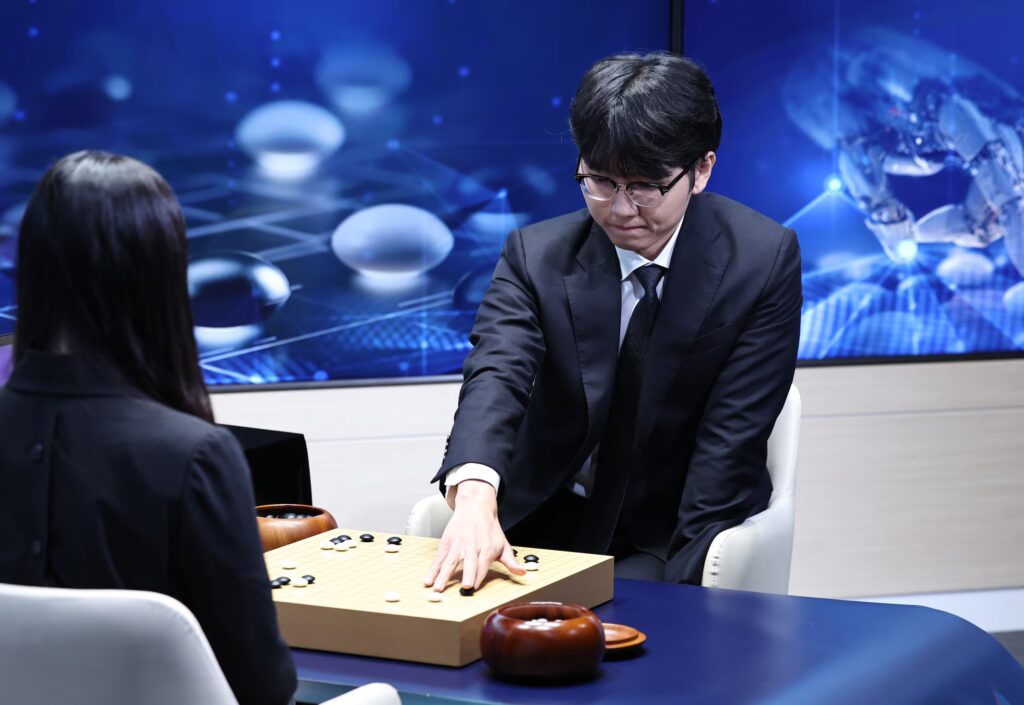
Ten Years After AlphaGo, the World’s Best Human Took Two Stones — and Still Lost Game 1
Shin Jinseo’s showdown with the open-source AI KataGo is a snapshot of how far the machines have come. Games 2 and 3 are this week.
In March 2016, AlphaGo beat Lee Sedol and changed Go forever. This week in Seoul, exactly a decade later, the Go world staged its first marquee human-versus-AI rematch — and the terms of the fight tell you everything about what those ten years did.
Shin Jinseo, the 26-year-old Korean who has been the world’s No. 1 player for the better part of a decade, sat down on July 17 against KataGo, the strongest openly available Go AI. Nobody pretended it would be a fair fight on even terms. Instead, Shin plays Black with a two-stone handicap — two free stones on the board before the game even begins — in a three-game series organized by Korea’s Hankyung media group to commemorate the AlphaGo anniversary.
He lost the opener anyway.
What a two-stone handicap means
For readers new to Go: handicap stones are how the game levels mismatched players, and among professionals even a single stone is a chasm. Two stones is roughly the gap between a world-class professional and a strong amateur — the kind of advantage that, between two humans at the top level, would make the result a formality. Ten years ago, Lee Sedol played AlphaGo dead even and won a game. Today, the honest betting line between humanity’s best player and a free, open-source program — written not by a tech giant but originally by one researcher, David Wu, and now the standard training tool in every pro’s laptop — is two stones. That shift is the story.
Shin knew it better than anyone. At the pre-match media day, he was disarmingly candid: in private practice, he had never once beaten KataGo at two stones, though he always won at three. Fighting the AI in complicated positions, he said, was close to suicidal — his plan was to keep the game quiet, bank his head start, and drag things to the endgame, the one phase where he felt his precision might hold up. He’d initially told himself one win in three would be a success, then talked himself into aiming higher.
Game 1: the plan works, until it doesn’t
For a hundred moves, the plan worked. KataGo opened with a small surprise — its first move went to a corner star point, when in practice games it had favored a different corner point, and it followed with an approach move rarely seen in human play — but Shin kept his composure and steered the game exactly where he wanted it: calm, territorial, and clearly favorable. At the start, with the handicap counted, the evaluation showed him nearly 20 points ahead with a 99% winning chance.
Then the margin began to leak. As the position grew more complex, KataGo’s flawless calculation kept shaving the lead, point by point. Around move 102, sensing the game slipping, Shin made the very choice he had warned himself against: he went for the throat, launching an all-out attack to kill White’s big central group. KataGo wriggled free — living with sequences that broadcast commentators described as moves that simply don’t exist in human Go, while poking at Black’s weaknesses along the way. Shin threw one last punch, starting a ko fight at the top of the board, but the game was gone. After 4 hours and 20 minutes, he resigned on move 245 with nearly two hours still on his clock.
Why it’s worth watching anyway
There’s real money on the table — Shin earns an appearance fee of 50 million won (about $36,000) per game, a matching bonus for each win, and a Genesis luxury sedan if he takes two of three. But nobody, least of all Shin, is framing this as human versus machine for supremacy. That question was settled years ago; Lee Sedol himself retired in 2019 saying as much.
The fascination now is different: it’s a precise measurement of the gap, taken by the one human most qualified to take it. Shin is famous for being the most AI-fluent player of his generation — his style is so closely modeled on engine play that Korean fans nicknamed him “Shin-gongjineung,” a pun on the Korean word for artificial intelligence. If anyone can steal a game from KataGo at two stones, it’s him, and for a hundred moves on Friday he looked like he might.
He gets two more tries: Game 2 on July 19 and Game 3 on July 21, played regardless of the score. One win would already be something no one has done in his practice room. We’ll be watching.

