


Two days after a painful Game 1 loss, the world No. 1 adjusted his strategy, kept his nerve through a ferocious center fight — and did something he’d never managed even in practice.
For the first time since Lee Sedol’s immortal Game 4 against AlphaGo in 2016, a human has beaten a top Go AI in a formal match.
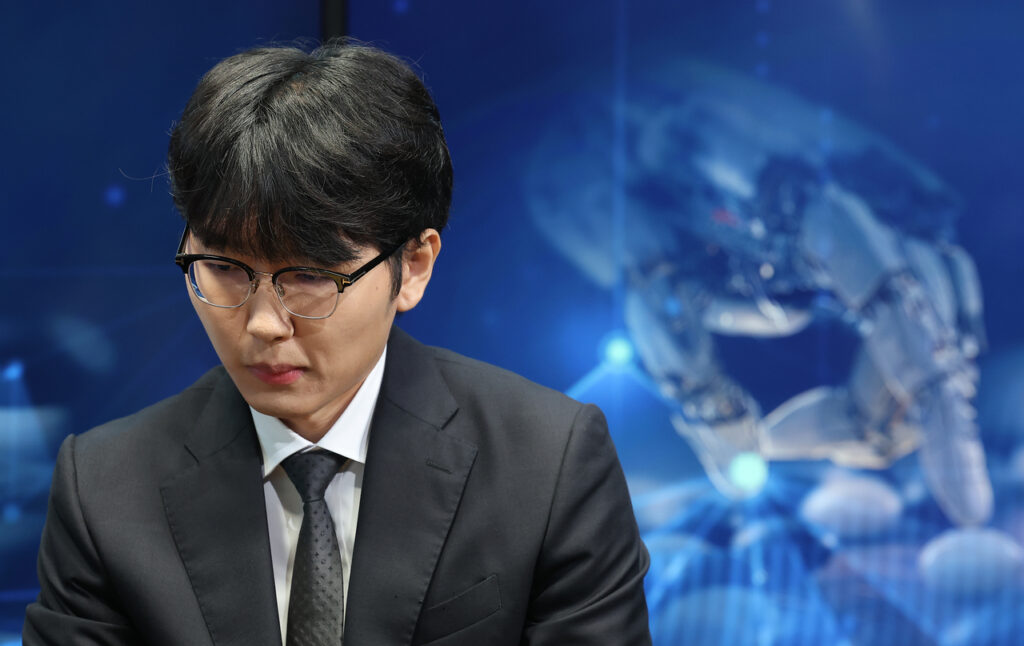
Shin Jinseo, the world’s top-ranked player, defeated KataGo on July 19 in the second game of their three-game series in Seoul, winning by 4.5 points after 290 moves and nearly five hours of play. The victory evens the “Kisinjeon” exhibition series at one game apiece, sets up a live finale on July 21 — and, yes, it comes with an asterisk the size of two stones: unlike Lee Sedol a decade ago, Shin plays with a two-stone handicap. Nobody is claiming the machines have been caught. But within the terms of this match, Shin did something remarkable — by his own admission at the pre-match press conference, he had never once beaten KataGo at two stones, even in private practice. On Sunday, with cameras rolling, he finally did.
Learning from Game 1
What makes the win satisfying is how it happened. In Game 1, Shin built a comfortable lead and then — against his own stated game plan — waded into an open-center brawl, the exact territory where an AI’s flawless calculation is most lethal. KataGo escaped his attack and buried him.
Game 2 was a masterclass in not making the same mistake twice. Early on, Shin steered the bottom-right corner into one of the longest established joseki in the book — a massive, largely forced sequence of moves. It might seem strange to play “book moves” against a machine that knows every book, but the logic is sound: forced sequences reduce the number of open possibilities on the board, and fewer possibilities means fewer chances for the AI’s creativity to bite. He paired that with clock management, sinking deep thought into critical moments while KataGo, bound by the match rules, had to answer every move within 20 seconds.
Starting roughly 18 points ahead thanks to the handicap, Shin never let the game out of his grip. His evaluated winning chances stayed above 98% for most of the day, dipping only once, to 89%, at the height of the crisis.
And there was a crisis. From around move 160, a fight erupted in the center — the open, structureless part of the board that human players find hardest and that had been Shin’s undoing on Friday. KataGo threw complications at him for thirty-plus moves, and this time Shin defused them, calmly letting three of his center stones go rather than fighting for every last point. Veteran professional and popular commentator Kim Sung-ryong singled out Shin’s move 180 as the game’s “divine move” — delightfully, an empty triangle, a shape so proverbially bad that it’s the first thing beginners are taught never to play. Good shape is what usually works; knowing the exception is what makes a world champion.
One more game, and a car on the line
When the counting was done, Shin had won by 4.5 points — a comfortable margin in a game where his Game 1 predecessor had resigned outright. Korean coverage allowed itself a little poetry: ten years after Lee Sedol’s lone win gave humanity its last great moment against the machines, a human had taken a game again.
The finale comes July 21, and the stakes are pleasantly concrete: Shin has already banked his win bonus for Game 2, and taking the series 2–1 would additionally earn him a Genesis G90 luxury sedan. More meaningfully, it would mean the world’s best human, given two stones, can beat the world’s most widely used Go AI more often than not on a given week — a data point that would have sounded absurd in either direction at different moments of the past decade.
Whatever happens Tuesday, the series has already delivered its real payload: two games of genuinely fascinating Go, a champion adapting in real time, and proof that even in the AI era, there’s still drama left on the board.

