


China took fourteen of the fifteen contested places — in Seoul, in Korea’s own building. The only Korean to survive is a 45-and-over qualifier and a former national team coach.
The Samsung Cup unified qualifier finished on August 30 at the Korea Baduk Association in Seoul, and the scoreline is the kind that gets a federation’s attention. Of the sixteen main-draw places on offer, China won fourteen. Singapore won one. Korea, the host nation, fielding 219 of the 386 entrants, won one — in the seniors division, restricted to players 45 and over.
Set the World division aside, since Korea, China, Japan and Taiwan don’t contest it, and the split of the fifteen tickets the four Go nations actually fought over reads: China 14, Korea 1, Japan 0, Taiwan 0. Japan entered 40 players and qualified nobody. Taiwan entered 21 and qualified nobody.
A clean sweep of the main division
The general division is the one that matters most, and it was a shutout. All twelve places went to Chinese players: Xia Chenkun, Fan Yin, Shi Yue, Tan Xiao, Xie Ke, Gu Zihao, Zhao Chenyu, Lian Xiao, Wang Shuo, Zhang Weijie, Li Qincheng and Yang Dingxin. Two Koreans reached the final round — Han Seungjoo and Kang Yutaek — and both lost, to Li Qincheng and Yang Dingxin respectively.
The women’s division came closest to a different result. Kim Eunji, who has spent the summer running up win streaks at home, reached the final and lost to China’s Zhou Hongyu by half a point. The new U-20 division went to China’s Tu Jikang. Xu Xiaofan took the World place for Singapore.
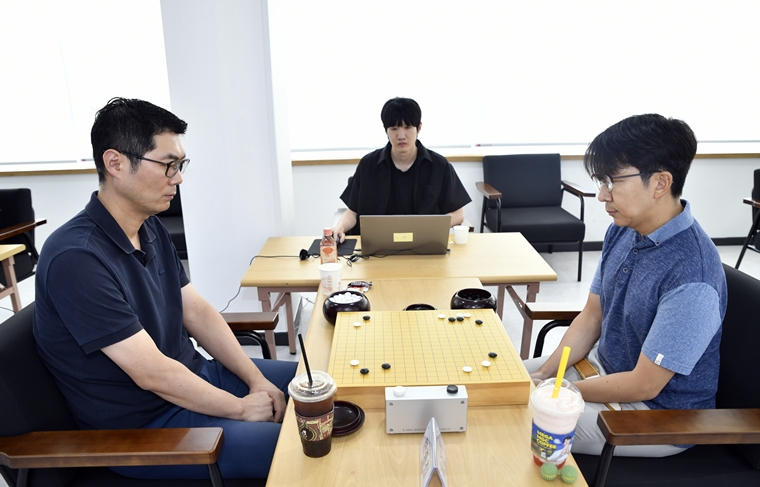
Which leaves Mok Jinseok. The 9-dan, who once served as head coach of Korea’s national team, beat Han Jongjin as Black by resignation at 163 moves to take the senior ticket and become the sole Korean to come through. It is his second year running: last summer he got there by beating Lee Changho, which put him in a Samsung Cup main draw for the first time in a decade. Afterwards he was matter-of-fact — pleased to be back, aware that he’ll almost certainly draw a Chinese opponent, and clear that qualifying isn’t the point if you don’t then perform.
Three years, one direction
The number that should worry Korean Go isn’t this year’s, it’s the sequence. In 2024, Korea took six places — two in the general division, and a clean sweep of the four women’s and senior tickets. In 2025, three: Kim Jiseok and Park Sangjin in the general division, Mok in the seniors. This year, one. China has gone 11, 11, 14 across the same three qualifiers.
It’s worth being precise about what this measures, though. A qualifier doesn’t rank the best players in the world; it ranks the players who aren’t already seeded. Shin Jinseo, Park Junghwan, Shin Minjun, Byun Sangil, Kang Dongyun and Kim Myounghoon all skipped the whole thing because Korea holds six national seeds, and Shin Jinseo remains the world’s top-ranked player by some distance. What the qualifier measures is depth — the layer immediately beneath the elite — and on that evidence China’s second tier is now stronger than most countries’ first.
That’s the uncomfortable part. Korea’s presence in world events increasingly depends on a handful of seeded names. When those six aren’t playing, the results look like this.
What November looks like
The main draw opens November 9 with the round of 32 starting the next day, at the Samsung Fire & Marine Global Campus in Goyang. First prize is 300 million won.
Do the arithmetic on the field and it’s stark: China arrives with roughly nineteen players once seeds are counted, Korea with seven, Japan with two — Shibano Toramaru and Fukuoka Kotaro, both entering on national seeds after Japan’s qualifier blank. Two wildcards remain unannounced.
Mok Jinseok will be one of the seven. A qualifier from the over-45 bracket, carrying his country’s only earned place into a field where more than half the room is Chinese. It’s a strange kind of honour, and he seemed to know it.

