


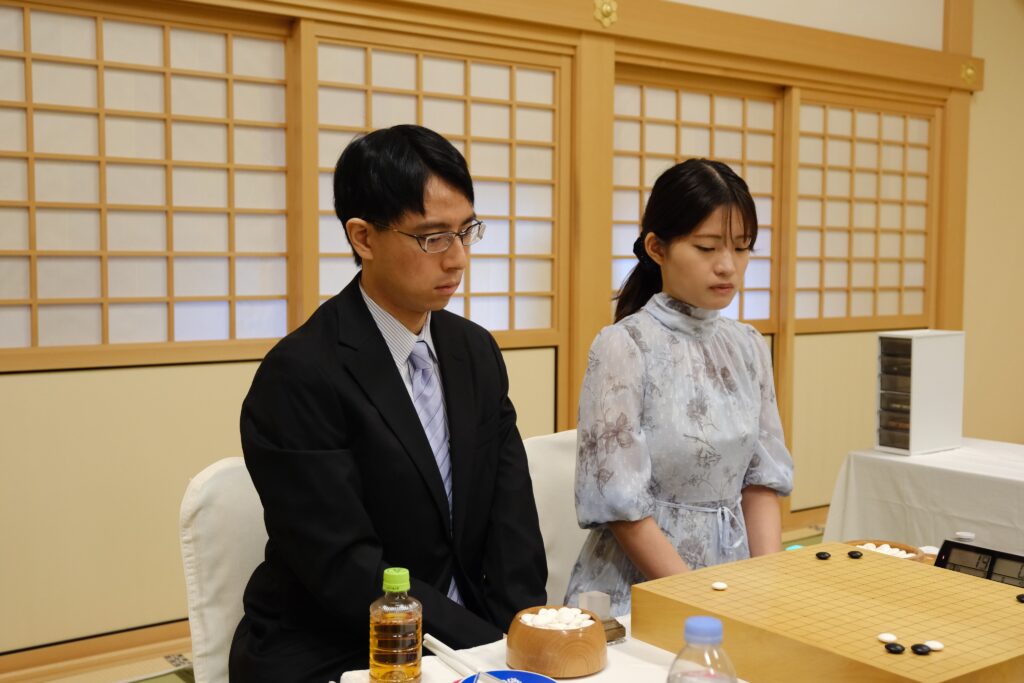
The first World Pair Go Championship in seven years went to Japan. Taiwan made the final after losing its opening game. Ichiriki now goes back to a tied Meijin series.
The Honmaru Palace at Nagoya Castle hosted a world final on Sunday morning. Fujisawa Rina and Ichiriki Ryo, playing White, beat Yang Zixuan and Hsu Haohung of Chinese Taipei by resignation on September 27 to win the World Pair Go Championship 2026.
The Japanese pair won all four of their games. Winning their first two sent them straight to the semifinals, and they didn’t lose after that. The prize was ¥5 million.
For Ichiriki the timing is notable. On Wednesday he is due in Toba for Game 5 of the Meijin, which stands at 2–2 against Shibano Toramaru. He heads into that game having just won a world title.
Back after seven years
The World Pair Go Championship was last held in 2019. This year it returned as the centerpiece of the Pair Go World Festival, an official cultural program of the Aichi-Nagoya Asian Games. Go is not a medal sport at these Games, so this cultural event was the closest it got to the Games themselves.
Eight pairs took part: three from Japan, two each from China and Korea, and one from Chinese Taipei. They played in two groups of four. A pair that won its first two games went straight to the semifinals, and a pair that lost its first two went home.
Fujisawa and Ichiriki took the direct route. They beat Zhou Hongyu and Ding Hao, then Kim Eunji and Shin Minjun, both times as White by resignation. In the semifinal they beat Iyama Yuta and Ueno Asami, also as White by resignation. That made it an all-Japan semifinal.
Afterward Fujisawa said Ichiriki’s deep reading had carried her through. Ichiriki pointed to what makes pair go appealing to him: when two players are in sync, they can turn a game around together.
Taiwan’s long route to the final
The most eventful run belonged to the runners-up.
Yang Zixuan and Hsu Haohung lost their first game to Kim Eunji and Shin Minjun. They then beat Zhou Hongyu and Ding Hao to stay alive, and played Kim and Shin again for a semifinal place. That rematch was the closest game of the week. At one point the AI gave Taiwan a 3% chance, and they won as Black by 1.5 points.
The semifinal was stranger still. Against Yu Zhiying and Wang Xinghao, the Taiwanese pair came back from an early disadvantage. Taiwanese coverage says the AI had them above 99% before the Chinese pair ran out of time in the endgame. The official result is a win on time for Black.
The final went wrong for them early: Black lost a large group, and a comeback attempt on the upper side came up short. Hsu said Yang’s composure under time pressure had been a big help all week. Yang admitted she’d been very nervous at the start and had grown in confidence after winning the second game. “Pair go is truly fascinating and fun,” she said, and added that she hoped they would play together again.
Second place, worth ¥2 million, ties Chinese Taipei’s best result in the event. The earlier one came in 2016, when Hei Jiajia and Chen Shih-yuan also finished second.
The rest of the field
China: Yu Zhiying won the first world pair title in 2016 with Ke Jie. This time she played with Wang Xinghao, and they won Group A with two wins, including a 4.5-point win as White over Choi Jeong and Byun Sangil. Then came the timeout loss in the semifinal. They finished third by beating Ueno Asami and Iyama as White by resignation. Zhou Hongyu and Ding Hao, the other Chinese pair, went out after two losses.
Korea: neither Korean pair reached the semifinals. Choi Jeong came in as the two-time champion; she won in 2018 and 2019 with Park Junghwan. With Byun Sangil she beat Ueno Asami and Iyama in her first game, then lost to Yu and Wang, and then lost a rematch against Ueno and Iyama that ended her run. Kim Eunji and Shin Minjun won their opening game and then lost twice.
Japan’s other pairs: Ueno Asami and Iyama Yuta finished fourth. On the way, they knocked out a pair that included Asami’s sister. In Round 2 they beat Ueno Risa and Sada Atsushi, who had won Japan’s professional pair go championship in 2025.
What’s next
For most of the field, the regular season picks up again straight away. Ichiriki’s is especially busy. After Game 5 of the Meijin on September 30 and October 1, he opens a Tengen defense against Iyama on October 7 and an Oza defense against Fukuoka Kotaro on October 23.

